
New Spatial Transcriptomics Study Reveals How Bone and Muscle Talk
Researchers from Tulane University used spatial transcriptomics to map how bone and muscle cells communicate, revealing key signaling pathways involved in musculoskeletal health and disease.
Researchers mapped cellular signaling networks between bone and skeletal muscle, decoding molecular pathways that coordinate tissue maintenance and repair
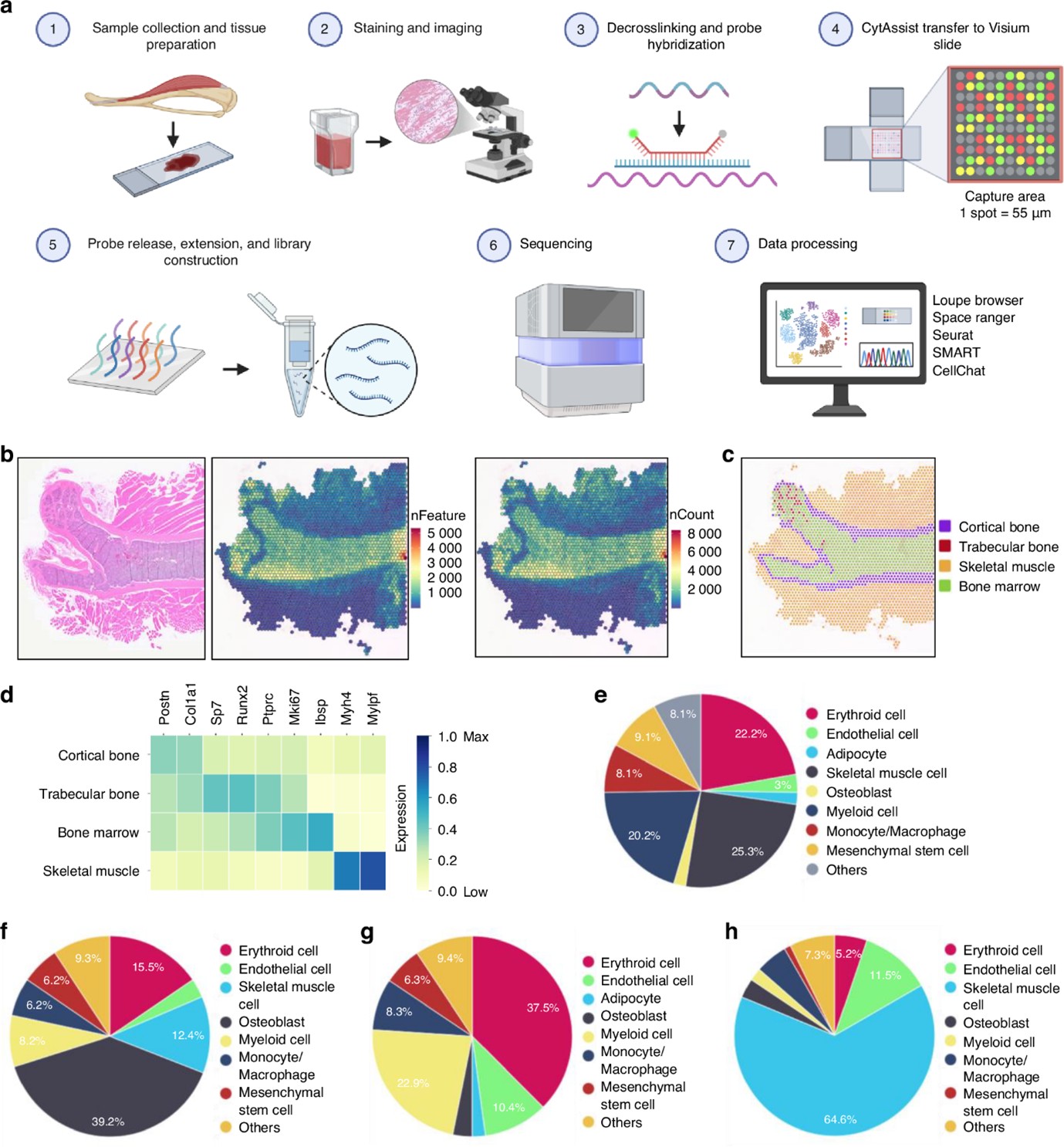
CHINA, July 6, 2026 /EINPresswire.com/ -- A new study generated one of the most comprehensive spatially resolved transcriptomic maps of cellular communication between bone and skeletal muscle in a young mouse. Using spatial transcriptomics, computational deconvolution, and ligand-receptor network analysis, researchers identified signaling pathways that coordinate tissue maintenance, remodeling, and vascular support. Key interactions involving collagen, thrombospondin, tenascin, and VEGF pathways were validated experimentally and across independent datasets. The findings provide a foundation for studying musculoskeletal disorders and aging.Bone and skeletal muscle are often viewed as separate tissues with distinct functions, yet they operate as a highly integrated system. Together, they support movement, maintain posture, regulate metabolism, and help preserve overall health. Scientists have long known that bone and muscle communicate through biochemical signals, but understanding exactly where these molecular conversations occur and which cells participate has remained a major challenge. Traditional genomic technologies can identify genes expressed within tissues but often lose the spatial information needed to understand how neighboring cells interact within their natural environment.
Addressing this challenge, a research team was led by Professor Hong-Wen Deng, Director at the Tulane Center for Biomedical Informatics and Genomics, Deming Department of Medicine, School of Medicine, Tulane University, USA. The researchers applied spatial transcriptomics, an emerging technology that maps gene activity directly within intact tissues, to examine a mouse femur and its adjacent skeletal muscle. By combining this approach with advanced computational tools, they reconstructed cellular neighborhoods and communication networks across the bone–muscle interface. The analysis generated data from 2,660 spatial spots and identified multiple major cell populations participating in tissue communication. Their findings were published in Volume 14 of the journal Bone Research on May 19, 2026.
The study revealed that bone and muscle are linked through a surprisingly complex communication system involving osteoblasts, skeletal muscle cells, endothelial cells, immune cells, and stem-cell populations. Researchers identified thirteen major signaling pathways that coordinate tissue maintenance and remodeling. Several of these pathways involved extracellular matrix proteins and growth factors that help cells exchange information, regulate structural integrity, and respond to physiological demands. The findings suggest that communication between tissues is not random but organized into distinct spatial networks shaped by local cellular environments.
One of the study's most significant discoveries was the identification of specific ligand-receptor pairs that act as molecular messengers between neighboring cells. These included collagen-associated signaling between osteoblasts and muscle cells, thrombospondin-mediated communication involving immune cells, and vascular endothelial growth factor (VEGF)-driven signaling that supports vascular function. Laboratory imaging confirmed the colocalization of several predicted molecular partners within the tissue, strengthening confidence in the computational predictions. Additional validation using independent mouse and human datasets supported many of the identified pathways, suggesting that some communication mechanisms may be shared across species.
“Our goal was to move beyond simply identifying which genes are present and instead understand how cells communicate within their native tissue environment,” explained Prof. Deng. “By preserving spatial information, we were able to uncover communication networks that would be difficult to detect using conventional sequencing approaches alone.”
The work also offers important opportunities for future collaboration across fields including bone biology, muscle physiology, regenerative medicine, aging research, bioinformatics, and precision medicine. Because disorders, such as osteoporosis, sarcopenia, and metabolic disease, often involve simultaneous deterioration of bone and muscle, a clearer understanding of tissue crosstalk could help researchers identify shared therapeutic targets. In the short term, the study provides a valuable reference map that scientists can use to investigate how these signaling networks change during injury, aging, or disease progression.
“Understanding these cellular communication pathways gives us a framework for studying what goes wrong in musculoskeletal disorders,” said Prof. Deng. “In the future, this knowledge may help guide the development of targeted interventions that restore healthy communication between tissues.”
Overall, the study delivers one of the first spatially resolved, transcriptome-wide maps of bone–muscle communication. By revealing how cells coordinate their activities through organized signaling networks, the research establishes a foundation for future investigations into musculoskeletal health and disease. Over the longer term, such insights could contribute to more precise diagnostic tools, improved regenerative therapies, and personalized treatment strategies aimed at preserving mobility and quality of life in aging populations.
Reference
Titles of original paper: Decoding cellular communication networks and signaling pathways in bone, skeletal muscle, and bone-muscle crosstalk through spatial transcriptomics in a young male mouse
Journal: Bone Research
DOI: https://doi.org/10.1038/s41413-026-00520-w
About Tulane University, USA
Tulane University is a leading private research institution located in New Orleans, Louisiana, USA. Founded in 1834, the university is recognized for excellence in education, biomedical research, public health, engineering, social sciences, and community engagement. Tulane fosters interdisciplinary collaboration across its schools and research centers to address complex global challenges through innovation and discovery. The institution is committed to advancing knowledge that improves human health, environmental sustainability, and societal well-being. With a strong emphasis on translational research and public service, Tulane continues to contribute impactful scientific advances with global relevance.
Website: https://tulane.edu/
About Professor Hong-Wen Deng
Hong-Wen Deng is Director of the Tulane Center for Biomedical Informatics and Genomics and a distinguished researcher in genetics, genomics, bioinformatics, and complex diseases. He earned his Ph.D. in Quantitative Genetics from the University of Oregon. His work spans osteoporosis, sarcopenia and precision medicine. He has authored nearly 500 peer-reviewed publications in leading journals and has received extensive research support, including multiple NIH grants. His research integrates large-scale multi-omics data to understand how genetic and environmental factors influence disease risk and health outcomes. He has mentored more than 100 trainees, many of whom have become successful academic and industry leaders.
Funding Information
This study was partially supported or benefited by the National Institutes of Health (grant numbers: U19AG055373, P20GM109036, R01AR069055, and R01AG061917).
Yini Bao
2885546461 ext.
email us here
Bone Research
Legal Disclaimer:
EIN Presswire provides this news content "as is" without warranty of any kind. We do not accept any responsibility or liability for the accuracy, content, images, videos, licenses, completeness, legality, or reliability of the information contained in this article. If you have any complaints or copyright issues related to this article, kindly contact the author above.
